Evolution has rendered wisdom teeth useless, and a high percentage of these unnecessary molars eventually require removal. When a wisdom tooth, otherwise known as a third molar, cannot erupt into proper alignment, it is called impacted. Oral surgery to extract impacted wisdom teeth may be considered if you have the following problems:
- Mouth pain and bite problems caused by damage to surrounding teeth created from crowding caused by the extra molars.
- Jaw and nerve damage caused by cysts that form around the impacted wisdom teeth.
- Sinus pain, pressure and congestion resulting from problems with wisdom teeth.
- Inflamed and infected gum tissue created because the area around impacted wisdom teeth is difficult to clean properly.
- Cavities which develop due to infected gums that allow pockets to form between gums, allowing bacteria to grow.
- Alignment issues that alter the effects of braces, bridges, crowns and partial dentures due the crowding created by impacted wisdom teeth.
To diagnose impacted wisdom teeth, your dental professional will look for signs of infection or swollen gums. Your dentist will also inquire about your regular oral hygiene habits. The diagnosis of impacted wisdom teeth can be confirmed with dental x-rays, which may also reveal damage to the other teeth or jawbone.
When making a decision with your dentist about wisdom tooth extraction, it’s important to consider your age. Typically third molars erupt between the ages of 16 and 25 years. Younger patients experience considerably fewer complications with oral surgery for wisdom tooth extraction than older adults.
If your dental professional recommends removal due to the diagnosis of an impacted wisdom tooth, ask for a referral to a qualified oral and maxillofacial surgeon to ensure a successful and complication-free oral surgery.
We treat patients from Fernandina Beach and the surrounding area
Once you’re an adult, you don’t have to worry about cavities anymore. Right? Wrong! It’s true that you should have mastered oral hygiene techniques, but there are different factors that can contribute to cavities that weren’t a big issue during childhood. What are some of the things that put you at risk for cavities once you’ve reached adulthood, and what can you do about them?
Diet
Often your diet is worse as an adult without even realizing it, and what you eat and drink directly affects your teeth and gums. Sugar is the biggest offender and all types of sugar counts, not just the obvious candy or sodas. Limit your consumption of juices, milk, crackers, sweetened coffee, fruits, and vitamin or energy drinks.
Grazing
Many people tend to “graze” on foods and drinks all day long. If you snack frequently, you’re giving bacteria a constant supply of sugars to mix with and damage your mouth. Even though it’s tempting to sip on coffee or soda all morning, it’s better to drink it in one sitting. Also consider using a straw to avoid your teeth completely.
Receding gums
If your gums pull away from your teeth, your tooth roots can be exposed to plaque. Older patients with gingivitis, or gum disease, are more likely to form cavities. If the roots of your teeth are uncovered, you are more susceptible to plaque buildup and tooth decay.
Previous fillings
Fillings you received earlier in life can contribute to adult cavities. The filling may weaken with time, allowing bacteria into any cracks. Your dentist will check existing fillings for wear and replace them if needed.
Medical conditions
People with lower saliva flow due to various illnesses are at higher risk of cavities. Cancer patients who have undergone chemotherapy or radiation are at more risk, as are smokers. People with limited manual dexterity may be unable to clean their teeth sufficiently.
Ways to decrease your risk
Brush with a fluoride toothpaste after meals, floss daily, and rinse with a fluoride mouthwash. See your dentist twice a year, and also inquire about fluoride treatments.
We treat patients from Fernandina Beach and the surrounding area
Many people find foods such as cheese, yogurt, and milk to be a very enjoyable part of their diet. Not only are some of these dairy items tasty and nutritious, did you know they can also help your teeth and gums? Studies show that consuming dairy products regularly can lower the occurrence of dental diseases. Let’s see which dairy items you should consider incorporating into your diet and why.
Reduce gum disease
The primary benefit of dairy to your dental health is lowering your risk of periodontal disease. Also known as gum disease, this condition affects roughly 75 percent of Americans at some level. It may be minor gingivitis or advanced periodontitis. If left untreated, gum disease can cause tooth loss, contribute to heart disease and stroke, and worsen diseases like diabetes and osteoporosis. Lactic acid is one of the key ingredients in many dairy items, and researchers believe that lactic acid is related to reducing gum disease.
Choose your dairy
Just because a food is identified as a dairy product, that doesn’t necessarily mean it’s completely healthy for you. Here are some tips to help you choose the ideal foods and beverages for your dental health:
- Look for low fat and non-fat options.
- Choose white milk instead of flavored milk, such as chocolate. The added sugars can lead to tooth decay.
- Consider natural and organic products when possible.
- Select unsweetened yogurt without sugar or artificial sweeteners. A good alternative is Greek yogurt which you can add fruit or honey to create an appetizing, healthy snack.
Enjoy additional benefits
Avoiding gum disease isn’t the only benefit of eating dairy. It helps build strong teeth and bones, and is rich in vitamins that are good for your overall health. So the next time you get hungry, try some cheese or a glass of milk because these foods will not only satisfy your hunger but also keep you smiling.
We treat patients from Fernandina Beach and the surrounding area
If you have lost all of your teeth or just a few, you are probably a good candidate for dentures. Dentures, also known as removable prosthodontics, are used for the dental restoration or replacement of missing or broken teeth. You may want to consider dentures if any of the following apply to your situation:
- You have very few remaining teeth and they are in poor condition.
- You have suffered bone loss in your mouth so severe it precludes you from considering dental implants.
- You have advanced gum disease that has resulted in the loss of multiple teeth.
- You have lost many teeth, and your remaining teeth are suffering from decay and receding gums.
- You are committed to practicing excellent oral hygiene in order to take good care of your dentures.
You may not be a good candidate for dentures if any of the following apply:
- You are a young patient whose jawbone has not fully developed.
- You grind or clench your teeth.
- You have a sensitive gag reflex.
- You are a smoker.
If you feel you are a good candidate for dentures, your dentist will evaluate the health of your teeth and gums and determine if full or partial dentures are the best choice for you. There are many factors to consider when having dentures placed, and your dental professional can help you make a decision that fits your needs and lifestyle. If you wish to regain oral functionality and improve your smile, dentures may be your answer to once again enjoying a full set of beautiful, natural looking teeth.
If you live in the Fernandina Beach area contact us today
Everyone wants to have a whiter, healthy smile. Home teeth whitening has become an extremely popular means to achieve those pearlier whites in the past couple of decades. In many cases, over-the-counter whitening kits are effective and safe. However, there are some disadvantages and risks to using over-the-counter home whitening kits:
- Off-brand whitening kits often contain dangerous concentrations of bleach or peroxide. This can cause erosion of the tooth enamel, and irritation to the sensitive gums and soft tissues of the mouth.
- Because many kits contain trays that do not adhere properly to your teeth, gums can become irritated and chemicals can leak out and be ingested causing stomach problems.
- Poorly fitted trays and varying concentrations of chemicals from lower quality kits may also result in unwanted discoloration of teeth or uneven results.
- Exposure to excessively harsh chemicals in off-brand kits can also cause gum shrinkage and oral infections.
When considering at-home whitening, it is best to stick to name brand kits to ensure the quality and safety of the treatment. Many popular brands of kits are both safe and efficient when used as directed. In any case, you should not consider at-home whitening if any of the following apply:
- You have deep, untreated cavities.
- You are pregnant.
- You suffer from gum disease.
The safest and most effective method for whitening your teeth is to have treatment by a dental professional, either in-office or with professional take-home trays. A qualified dentist can whiten your teeth up to ten shades in as little as one office visit. Consult with your dentist before pursuing any type of whitening treatment to ensure you will achieve the whiter smile you desire in the safest and quickest manner possible.
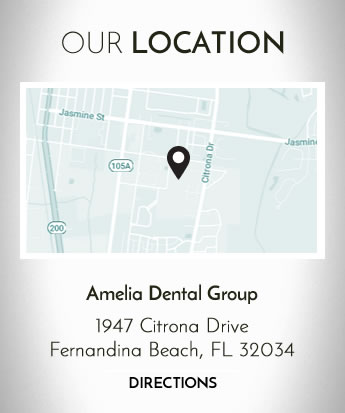
Our dental office is located in Fernandina Beach
What is a dental crown?
- A dental crown encases a damaged tooth completely within a custom-fit cap, or crown, fitting perfectly over the affected tooth. A dental crown is designed specifically for you and your tooth’s particular design, fit and function. It is a restorative therapy that can restore function to a tooth that may have had excessive decay, has been cracked or has recently undergone root canal treatment.
How do dental crowns work?
- A dental crown covers a damaged tooth entirely and can be used to improve not only the tooth’s appearance, but also its shape or alignment.
What is a dental bridge?
- A dental bridge makes a literal bridge between two anchor teeth, filling a gap left by a missing tooth that has either fallen out naturally or is the result of acute decay or facial trauma. Dental crowns cover the bordering anchor teeth, allowing the bridge to fit securely and to function as your natural tooth.
What materials are used for dental crowns?
- Dental crowns can be porcelain (ceramic), porcelain-fused-to-metal, or gold or other metal alloy. Porcelain or ceramic crowns can be designed to closely match the color and translucency of your natural teeth. Metal alloys are usually stronger, and are a better choice for back teeth.
Is a dental cap a crown?
- Yes! A dental cap is another name for a dental crown.
Am I a candidate for a dental bridge?
- If you are missing a tooth and you have adjacent teeth that are stable, dental bridges are for you. Even if you are missing a front tooth or a tooth that has only one border, there are types of dental bridges that could meet your needs.
Are there alternatives to a dental bridge?
- Dental implants are rising in popularity as technology has improved. A dental implant can restore a single tooth or can restore several, and are the standard of care for the replacement of a missing tooth today. Because a dental implant continues to stimulate the jawbone, it doesn’t lead to bone loss over time.
If you live in the Fernandina Beach area contact us today