Severely damaged, injured or diseased teeth can lead to not only cosmetic problems with your smile, but also functional ones. Your dentist may recommend dental crowns or dental bridges to treat your dental issues.
Dental crowns are a restorative dental therapy that covers the affected tooth completely, serving as the new outer surface of the tooth. A dental crown maintains the natural roots of a tooth and can prevent extraction. A dental bridge fills the gap left by one or more missing teeth and is affixed to bordering teeth with an anchoring crown.
Both dental crowns and dental bridges are made from a variety of materials that can be designed to match the color of your surrounding natural teeth. As opposed to removable prosthodontics such as full or partial dentures, dental crowns and bridges are permanently bonded to existing teeth or dental implants, allowing them to function and appear as natural teeth.
Dental crowns and bridges have a number of advantages and benefits, such as:
- Dental crowns protect the natural tooth after a root canal therapy, helping to prevent bacteria re-infecting the tooth that could lead to extraction.
- Dental bridges restore gapped or missing teeth, providing support to the surrounding teeth, preventing them from shifting in to fill the empty space and affecting your speech, bite and smile.
- Your dentist can typically place dental crowns and bridges in as few as two appointments.
- Dental crowns and bridges are both long-lasting, durable therapies, designed to protect your natural tooth for years to come.
- Dental crowns prevent bone loss by preserving the natural tooth roots, thereby stimulating the jawbone, preventing resorption, or shrinkage, of the bone following extraction.
If you have questions about what a dental crown or bridge can do to improve the form and function of your smile, talk to your dental professional today. You can restore your healthy smile and preserve it for years to come with a dental crown or dental bridge treatment.
We look forward to seeing you in our Fernandina Beach dental office
Finding the right dentist is an important decision because it’s a healthcare relationship that can last a lifetime. The need for dental care starts around age one and continues through senior adulthood. For routine dental care, you might choose to see a family dentist or a general dentist. Although there are some similarities, the two types of dentists have some unique aspects.
Services:
Both types of dentists offer routine services that are common to oral health care. This includes examinations, cleanings, x-rays, and fluoride treatments. Instructing patients about dental hygiene such as proper brushing and flossing is part of most family and general dentistry practices as well. Poor oral care can cause decay, infections, gum disease, or other problems. Both types of dentists also offer treatment for when problems arise, such as dental fillings.
Patients:
General dentists often cater to patients in a certain age range, but family dentists provide treatment for patients of all ages. Infants, children, adolescents, adults, and seniors are all able to seek oral health care from a family dentist. Each age group has unique needs and issues, but family dentists are skilled in caring for everyone.
Specializations:
Since they see all ages of patients, family dentists are skilled in a wide variety of procedures. They are able to diagnose and treat many oral health conditions, including gum disease and oral cancer. Typical procedures they offer include tooth extractions, root canals, fillings, crowns, bridges, and sealants. Some are able to perform specialty services like implants and veneers. Many patients enjoy being able to obtain treatment from their family dentist without having to see a specialist.
Benefits:
In addition to the benefit of getting a variety of treatments in one location, family dentists are also able to provide ongoing treatment for all household members. Children and parents go to the same location and can even request back-to-back appointments. Everyone learns the same dental care techniques that they can practice at home together. Family dentists encourage every member of the family to take pride in their oral health.
We treat patients from Fernandina Beach and the surrounding area
Each year, more than 30,000 Americans receive an oral cancer diagnosis. Unfortunately, less than 57 percent will live beyond five years. In fact, the death rate for oral cancer is higher than cervical cancer, Hodgkin’s disease, brain cancer, and liver cancer. Usually seen in older patients, oral cancer in individuals under 40 is on the rise.
Fast Facts about Oral Cancer
• Early detection increases the survival rate to almost 90 percent.
• Initially, oral cancer patients may have few obvious symptoms of the illness.
• Certain factors, such as gender, lifestyle choices, and age can increase your risk of developing oral cancer. An estimated 25 percent of oral cancer patients, however, have no risk factors for the disease.
• Famous people who have battled oral cancer include Michael Douglas, Roger Ebert, Aaron Spelling, Humphrey Bogart, Eddie Van Halen, and Babe Ruth.
• Signs of oral cancer include a sore that does not heal after two weeks, color change in oral tissue, hoarse or scratchy throat, and difficulty with chewing or swallowing.
• Side effects of oral cancer may include chronic discomfort, loss of oral function, and difficulty in chewing, swallowing, or speaking.
• Research suggests that a diet rich in fruits and vegetables decreases your chances of developing cancerous lesions.
• Routine dental visits allow your dentist to look for signs of oral cancer, which can lead to early detection if there is a problem.
• Tobacco and alcohol use can result in a 75 percent chance of receiving an oral cancer diagnosis.
We look forward to seeing you in our Fernandina Beach dental office
When you visit the dentist, you often see other professionals in the office. Usually, the dentist will have a hygienist and a dental assistant as part of the team. While their roles aren’t the same as the dentist’s job, these individuals do play an important part in your dental care. Understanding what the hygienist and dental assistant do can make you feel more comfortable at your dental appointments.
The Dental Assistant
To become a dental assistant, an individual usually completes course work through a community college or technical school. This training will provide hands-on experience before the dental assistant works in an actual dental practice. A dental assistant can serve many functions, including assisting the dentist during treatment, taking impressions, sterilizing instruments, and making temporary crowns for patients. Dental assistants also welcome patients and help them feel comfortable in the dental office.
The Dental Hygienist
At a minimum, a dental hygienist must earn an associate’s degree, though many hygienists choose to obtain four-year degrees. Additionally, hygienists must be licensed in the states where they practice. The dental hygienist is generally responsible for taking patient x-rays, performing an initial periodontal assessment, and cleaning your teeth. During your appointment, the hygienist will also offer tips on home hygiene to help you maximize your oral car routine. A dental hygienist may also perform deep cleanings for gum disease, apply fluoride, remove sutures, and administer local anesthetic.
Your good health depends on taking excellent care of your teeth. Not only does proper dental care protect your oral health, but it also has a major impact on your overall health. Routine brushing and flossing are just the start. Establishing a relationship with a good general dentist is a vital part of taking care of both your dental health and your general health.
The focus of general dentistry is to stop minor dental problems before they become large health issues. While many dentists now offer cosmetic and restorative treatments, the main responsibility of a general dentist is preventative. Treating cavities, performing root canal treatment, and performing regular cleanings and examinations are some of the important things services by a general dentist.
Even if you take vigilant care of your teeth, only a qualified dentist or hygienist can remove the plaque and tartar that forms around and below your gum line. Regular checkups allow your general dentist to detect problems that could potentially lead to more serious issues. Caught in the early stages, potential trouble like gingivitis or periodontitis can be successfully treated before they become bigger concerns. General dentistry procedures like scaling, root planning, and root canal treatment can be used to save infected teeth.
Prevention is the key to a healthy smile. Taking proper care of your teeth at home and keeping a regular schedule of cleaning and exam appointments with your general dentist will go a long way towards saving your smile for years to come.
Our dental office is located in Fernandina Beach
Why wait until you have a toothache, bleeding gums, bad breath, or other problems to decide it’s time to start focusing on your oral health? Your mouth and your whole body can benefit from maintaining good oral health. Here is some simple advice that will help you along the path to a healthy smile.
Brushing and flossing
Tooth decay and gum disease are both preventable with proper brushing and flossing. Brush with a soft-bristled toothbrush and fluoride toothpaste, using a circular motion. It’s best to brush after every meal, but twice a day should be the minimum. Gently floss your teeth daily to remove food particles and bacteria between your teeth.
Eating right
Focusing on eating foods from each food group will aid your oral health in addition to your overall health. Not getting essential nutrients in your diet increases your risk of gum disease, and also makes it more difficult for your body to resist infection. Eat low fat dairy items, lean proteins, vegetables, fruits, and whole grains. Look for foods low in sugar, which can lead to tooth decay. Avoid snacking too much during the day when you aren’t going to brush your teeth afterwards, and drink plenty of water throughout the day.
Seeing your dentist
Visit your dentist at least twice a year for checkups. During these appointments, your dentist will look for problems and professionally clean your teeth. Delays in treatment of some conditions can cause them to worsen to the point that treatment may be more painful, difficult, or costly. Your dentist will help you keep your teeth and gums healthy so that you can keep smiling as long as possible.
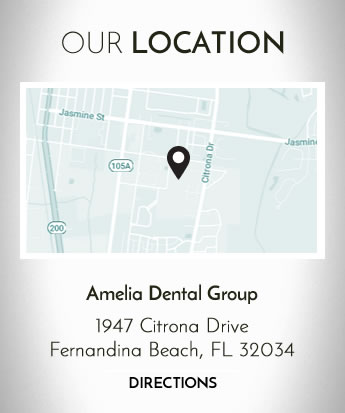
Our dental office is located in Fernandina Beach